Showing posts with label risk for pregnant women. Show all posts

Friday, December 19, 2014

BEWARE OF CARAMEL APPLES


We have a bad “holiday spoiler” food outbreak in the United States. It’s caramel apples. Several people have died, and many more are seriously ill. So far there is no actual recall, because we don’t know what brand of caramel apple is involved.

Here are the latest numbers from this food threat according to the CDC:

o Case Count: 28
o States: 10
o Deaths: 5
o Hospitalizations: 26

You’ll notice that there aren’t that many conclusively identified cases, but of these, a very high percentage ended up in hospital, and the death rate is also high.

The bacterium involved is Listeria once again. For those of you who have read the book (The Safe Food Handbook: How to Make Smart Choices about Risky Food), or who read this blog regularly, you will know that Listeria monocytogenes is often present in prepared foods – especially deli meats, sandwiches, salads, cheese and similar. This is the first case I can recall of it turning up in caramel apples.

Unfortunately, this tiny bacterium is a huge danger to pregnant women. Young children are also at more serious risk. In fact, in this case, nine of the serious illnesses were pregnancy-related (that is, they occurred in a pregnant woman or her newborn infant). Three of the very serious “invasive” cases were among otherwise healthy children, ages 5-15.

So what can we do to be safe? At the present time, the official CDC advice is for consumers to avoid all caramel apples – plain, with nuts, chocolate, sprinkles, or anything else. It could turn out to be one of the toppings, or the caramel itself. It seems that you can still keep eating caramels though. I am delighted that we don't need to give those up as well.

Investigators are hard at work trying to identify which ingredient in the caramel apples is contaminated, and the brand involved. I guess they won't have much time off this year.

To your good health,
TSF

Thursday, May 22, 2014

ANOTHER TRADER JOE'S RECALL FOR HUMMUS

Trader Joe's happens to be one of my regular stores for shopping. It is convenient, well run, health conscious, efficient and carries many products I like at reasonable prices - such as cheeses and breads, and the food my dog prefers. If it was a publicly traded company, I would definitely buy shares in it.

But at the same time, I am constantly worried by the number of risky ready-to-eat products Trader Joe's carries. its rather erratic approach towards product dating and stating country of origin, and the number of product recalls it has had over the years. Many of them have been covered on this blog: recalls for trail mixes, peanut butter, nuts, dips, prepared salads, bagged greens, sliced apples, granola bars, cookies, hummus, dips, and more.

Now there is yet another recall for hummus. Nor is this the first hummus recall it has had. There was one back in April 2012 for instance. I blogged it.

This time, Massachusetts prepared foods manufacturer Lansal Inc.(also known as "Hot Mama’s Foods"), has announced that it is recalling some 7 tons of hummus and dip products due to possible Listeria monocytogenes contamination. As readers of this blog know, this is a particularly dangerous bacterium for pregnant women and for young children, sickly or elderly people.

Trader Joe's was not the only large chain that sold the possible dangerous hummus products. Target stores nationwide also carried them. Those of Trader Joe’s, as well as Giant Eagle were distributed to multiple states in the U.S.

I have to confess that I used to buy hummus at Trader Joe's. But after the 2012 recall, I decided it was too unsafe. A friend gave me a very easy recipe for making it at home, and I am glad she did.

You may also want to consider doing so. Listeriosis infection is no joke.

To your good health,

TSF

Thursday, April 3, 2014

HOW DO YOU KNOW THAT YOU HAVE LISTERIOSIS?

Listeriosis is caused by a tiny and innocent looking microorganism called Listeria monocytogenes which turns up quite frequently in our food supply. One of the biggest problems is that it is so hard to know if you have caught it.

Popular food items that most often carry this bacterium are Mexican-style cheese (queso fresco or queso blanco) or other cheeses made from unpasteurized milk, deli (ready-to-eat and supposedly “fully cooked”) meats, and raw vegetables and sprouts (the bacterium exists in the soil and water). Ready-to-eat or “convenience” foods (such as sandwiches, salads, snacks) are increasingly a culprit, because many food service workers carry this bacterium and can contaminate the food during preparation. There are several other posts on this blog discussing which particular foods you need to avoid.

If you are healthy and not pregnant, you don’t need to worry about Listeriosis. You might only feel a little bit “off” for a few days, or not even feel ill at all even if you do get a dose of it. But if you are pregnant (see previous post) or have a weakened immune system, you have to do your very best to avoid foods that could carry it. Should you catch it anyway, you need to get to the doctor as quickly as possible.

So how do you know if you might have it? The symptoms are usually ones like nausea, diarrhea, fever, headache and muscle aches, which could easily be confused with the ‘flu. If the infection becomes “invasive” (that is, the bacteria enter the blood causing bloodstream infection, or, the central nervous system, causing meningitis) you might even have convulsions, a stiff neck and feel disoriented, confused or suffer loss of balance.

A big problem for pregnant women is that they often only experience fever and other very vague symptoms. Other people with weakened immune systems, such as people with cancer, cancer treatments, or other serious conditions (like diabetes, kidney failure, liver disease, and HIV/AIDS) are more likely to have the full range of symptoms.

Remember too that just because you are sure you didn’t eat any “risky” foods in the last week or so, doesn’t mean you don’t have Listeriosis. It could be something you at as long as 20 or even 30 days ago, as sometimes symptoms of this disease take a very long time to develop. Go to a doctor anyway.

Listeriosis is usually treated with antibiotics during pregnancy. These antibiotics, in most cases, will prevent infection to the fetus and newborn. So quick action is important.

To your good health,

TSF

Monday, June 25, 2012

BAGGED SALADS SOLD AT WALMART AND KROGER ARE RECALLED


Yes, we have yet another recall of bagged fresh salads because of Listeria monocytogenes bacteria.

This time the recalling company is Dole Fresh Vegetables. The products were sold at Kroger and Walmart stores in Georgia, Kentucky, North Carolina, South Carolina, Tennessee and Virginia.

Here are the ones recalled at the present time (remember, these types of recalls often expand):
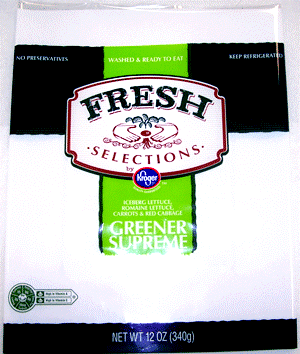
Kroger Fresh Selections Greener Supreme with Use-by date of June 19, Kroger Fresh Selections Leafy Romaine with Use-by date of June 19, and Wal Mart Marketside Leafy Romaine with Use-by date of June19.

As usual, whenever Listeria monocytogenes is the food contaminant, pregnant women, and anyone with a weak immune system take special note. Avoid these salads. In fact, for good measure, avoid all bagged salads, at least for a while, until we see whether more are recalled.

To your good health,
TSF