Showing posts with label food industry. Show all posts

Thursday, May 5, 2011

A RECALL OF GRAPE TOMATOES

An industrialized food supply, such as the one in the United States, certainly makes food safety more difficult. Take the presently ongoing recall of grape tomatoes. It's Salmonella bacteria again (there are 30 posts on Salmonella already on this blog). Here are the facts so far - and I would guess that this recall will expand in the days to come.

It all started with a farm based in Estero, Florida, USA. They sent their grape tomatoes to Six L Packing Company, another Florida-based enterprise, that packages and distributes food products. According to Hoover's, Six-L packs and ships over 15 million boxes of tomatoes a year to other food companies and retailers in California, North Carolina, South Carolina, Alabama, Florida, New Jersey, New York, Michigan, Pennsylvania and Georgia, as well as Canada. In New York, a U.S. Department of Agriculture inspector found that some of these tomatoes tested positive for Salmonella bacteria. As often happens, the test results came a little late. At least two of Six L's clients had already sent them to our stores.

Taylor Farms Pacific Inc., which is based in Tracy, California, had used them to produce some 60 kinds of fresh salads. They were being sold in plastic trays at deli counters in key supermarkets including Albertsons, Raley's, Safeway, Savemart, Sam's Club and Walmart stores across the West and some Midwestern United States. (See post May 3).

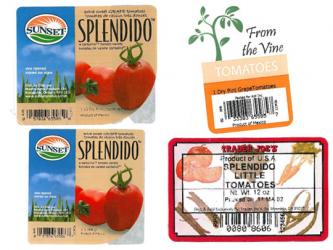
Wait - it gets weirder. Mastronardi Produce of Kingsville, Ontario (yes, that's Canada), also received some of the Six L grape tomatoes and is selling them under labels of "Aldi From the Vine (where else would they come from?) Grape Tomatoes", "Sunset Grape Tomatoes", and "Trader Joe's Splendido Little Tomatoes" all in neat little clamshell packages. And where are these being sold? Well, back we come across the border to the U.S. The Trader Joe's ones are being sold only in Eastern Seaboard and Midwest Locations. The others are sold in several other states (IL, MI, WI, FL, MA, MD, NJ, MD, OH, TX, WI). Did you notice, by the way, that some of those cute little grape tomatoes came right back to Florida again - presumably, from Ontario, Canada, under a new name?

Now comes my punchline. On April 26 - just about a week ago - representatives of Mastronardi Produce/SUNSET® were in Washington DC to accept the prestigious Dupont Food Quality Award for 2010. This award honors a North American business for outstanding food safety initiatives (There is a nice photo on their website of the award presentation). Mastronardi Produce won because “all aspects of the business appear to be aligned toward producing high quality, safe food within a sustainable environment.”

Hmm..Bad luck Mastronardi. You had better change the source for your grape tomatoes if you want to get the award next year.

TSF

Saturday, April 16, 2011

MRSA BACTERIA IN U.S. MEAT?

Recently published findings about drug resistant bacteria in U.S. meat is raising hairs - and blood pressure - among consumers. Disease-causing bacteria in our food are bad enough, but when they are also resistant to antibiotics, then its really scary. How can we be treated if we catch them?

A study published in the reputable journal of Clinical Infectious Diseases on April 15 is the cause of the furror. Testing on beef, chicken, pork and turkey for sale in U.S. stores in cities of Chicago, Los Angeles. Washington, D.C., Fort Lauderdale in Florida, and Flagstaff in Arizona, found that about 47 percent of the meat was contaminated with Staphylococcus aureus . And, it found that over half of these bacteria were resistant to at least 3 kinds of antibiotics. Some were resistant to more. Reportedly, at least one meat sample contained MRSA.

It seems that genetic testing argues that the bacteria came from the animals themselves - not from handling or packaging or some other source. If you have read The Safe Food Handbook, you won't be surprised. You also won't be surprised that the bacteria are antibiotic resistant, since the book explains why such bacteria are on the increase in meat and farmed seafood.

Industrialized food production is to blame. The popular practice in the United States is to give food animals small doses of antibiotics on a regular basis to keep them from getting sick, and fatten them up faster. No, it is not to treat illness - this is strictly preventive. And, it is profitable for the meat and the pharmaceutical industries.

The United States is behind the European and many other industrialized countries in banning this dangerous over-use and misappropriate use of drugs. Yes, it may help to keep our meat and poultry cheap - which is the argument of the industry. But is it worth creating a huge risk for public health?

TSF

Tuesday, February 8, 2011

THE FOOD RECALL MYTH


I have always wondered how much of the "bad" food recalled by food companies (often under pressure from federal agencies) was actually recovered. So today I did a simple analysis of the past 6 months of the recalls conducted by the U.S. Department of Agriculture (USDA).

Why look at the USDA rather than the Food and Drug Administration (FDA)? Well frankly, because I had their data handy. They helpfully just publicized their closed recall file for 2010 which listed the amount of product reported as recovered. All I did was go back to the original recall notice, and add the amount of product actually recalled in the first place. I only did it for the past 6 months, as it was the same pattern for the previous 6, and the list was getting too long (and, admittedly,the task was boring). By the way, I doubt findings for the FDA would be much different.

Notice the difference between product recalled and actually recovered in all but two cases. So where did this missing recalled food go? I would bet it didn't get lost in transit. The chances are, that we ate it. In many, if not in most cases, food recalls come too late - at least in the United States. And as you can see, too little is recovered.

Here's the list.

-- Raw Pork Paste and Ready-to-Eat Fried Pork Loaf, Dec 8, 2010. Recalled 2,182 lb. Actually recovered, 204 lbs.

-- N.Y. Gourmet Salads Products Dec 2, 2010. Recalled 12 products, (unknown total weight) . Actually recovered, 0 lbs.

-- Appetizer Products (Listeria), Nov 23, 2010. Recalled 57 lbs. Actually recovered, 566 lbs (This is very unusual).

--Spicy Thai Style Pasta Salad (Salmonella), Nov 5, 2010. Recalled, 7,325 lbs. Actually recovered, 2,012 lbs.

--Canned Meat and Poultry Products .Nov 4, 2010. Recalled, 12,086 lbs. Actually recovered, 495 lbs.

--Spicy Vegetable Potstickers .Oct 4, 2010. Recalled 1,608 lbs. Actually recovered, 420 lbs.

--Cured Uncooked Pork Ginger Sausage Sep 24, 2010. Recalled, 29, 893 lbs. Actually recovered, 5,019 lbs.

--Ground Beef Products . Aug 28, 2010. Recalled, 8,500 lbs. Actually recovered, 0 lbs.

--Marketside Grab and Go Sandwiches. Aug 23, 2010. Recalled, 380,000 lbs. Actually recovered, 168,249 lbs.

--Canned Meatball Products Aug 3, 2010. Recalled 147,667 lbs. Actually recovered, 118,892 lbs.

--Chicken Nugget Products . Jul 19, 2010. Recalled, 91,872 lbs. Actually recovered, 33,072 lbs.

--Fully Cooked Turkey Breast. Jul 7, 2010. Recalled, 17.5 lbs. Actually recovered, 17.5 lbs.

--Firehouse Jerky Beef Jerky Products Jul 6, 2010. Recalled, 8,000 lbs. Actually recovered, 2,901 lbs.

-- Beef Stroganoff with Noodles.Jun 30, 2010. Recalled, 600 lbs. Actually recovered, 0 pounds.

My point: Don't rely on food recalls to keep you safe. They won't.

Enjoy!

TSF

Tuesday, January 11, 2011

RECALLED NJ GROUND BEEF - REDUX


Even CNBC is announcing the latest ground beef recall - all of 200,000 pounds of ready-to-cook hamburgers. (By the way, I blogged this recall yesterday already). Of course - food recalls affect the health of companies as well as health of the public,so reporting recalls is quite natural for a leading business website.

But this is not really a case of exceptionally huge amounts of meat being recalled. Not in the day of mass-produced food. Nor is it that unusual a food recall. Hamburger meat and ready-to-cook frozen hamburgers are recalled all the time by different companies in the business.

But there are two interesting facts that CNBC and most other news reports are not telling you about this recall - yet. One is that this is a case of American business at its worst - that is, unethical, with no concern for public health (see yesterday's blog). The other interesting fact - and I am still checking it to make sure I have it straight - is that the OneGreat Burger Company is physically linked to the former Topps Meat Co. LLC. Topps was a nice family-owned company, which prided itself on its safety procedures. This obviously did not prevent E.coli 0157 from being found in its frozen hamburgers, resulting in their having to recall 21.7 million pounds of frozen hamburgers. (Now there's a big recall - in fact, the second largest beef recall in U.S. history). Topps was, up to that point, the largest manufacturer of frozen hamburgers in the U.S. It had been in business for 67 years, and this was its first recall.

That huge recall tipped Topps into bankrupcy back in 2008 (It already closed its plant in 2007). During the bankrupcy proceedings, an affiliate of Hawthorne-based Premio Foods, a sausage maker, then acquired the remainder of the Topps lease at its New Jersey plant, together with its flash-freezing equipment for $250,000. It set up the not-so-great One Great Burger, of Elizabeth, N.J.(The Topps name was bought by another company). Now IT is being faced with a huge recall, and not just because its burgers were smelly and spoiled - and could be contaminated. Because it broke the food safety rules.

What would be really ironic is if Premio Foods was then forced to sell off the meat plant, and the Topps former ownership bought it back at a bargain-basement price. Redux, with reversal of roles.

TSF

Thursday, January 6, 2011

FOOD RECALLS 101


Friends have been asking me to explain food recalls. So here are the basics on how they operate in the United States. But keep in mind that the actual situation is much more complex - and may be changing under the new food safety laws.

Why do food recalls take place? Because a food product that is contaminated, adulterated or mislabeled has got into our food supply, and needs to be quickly removed before it causes harm.

Who does the recalling? Recalls are almost always done by the food company responsible for releasing the product. They have to pay the costs of getting the products back, and suffer the negative publicity, damage to their brand and liability threats.

What does government do? At present, government can request, but not order a company to recall a dangerous food product (except in the case of infant formulas and foods which are "vectors of communicable diseases"). And yes, it can lean on the company pretty heavily at times, even to the point where it eventually forces the company to do the recall, or, go out of business. The two federal agencies involved are the Department of Agriculture and the Food and Drug Administration, depending which food product is involved. How they deal with the culprit company varies to some extent.

How voluntary are recalls? The game that is played - and the language often used in recall notifications - is that the recall is "voluntary" or even "precautionary, voluntary." Sometimes even words such as "out of excess of caution" are used. But let's face it - what company wants a recall?

What should consumers do if they hear of a recall? Yes, "if" is more correct than "when" - since many people don't hear about food recalls, and many food products that are recalled don't even reach the FDA or USDA public alert system. What consumers should do is to : 1) check whether these products have been sold in their state and their area stores; 2) check whether they have bought and/or eaten any recently; 3) avoid purchasing any until the "all clear" is issued. On the last point: don't assume that your stores always quickly remove recalled foods from their shelves , or have a checkout block that stops you buying them. Some slip up, or just don't hear about the bad news (usually smaller stores). All said and done, you have to take care of yourself.

TSF

Wednesday, December 29, 2010

SALMONELLA GETS WORST FOOD THREAT AWARD


I am doing some end-of-year thinking today. Among other things, I took a look at what the Food and Drug Administration considers to be "Major Public Health Threats" in our food. There are five food product recalls that the FDA presently classifies under this heading, taking place over the past two years (actually, less, since it is not up-to-date). The number of products recalled represents the latest information made available by the FDA (and also, may not be quite up-to-date, but it gives you the general picture).

Here they are:
Shell Egg Recalls (94 egg product recalled)
Hydrolized Vegetable Protein (HPV - a flavor enhancer) Containing Product Recalls (177 products recalled)
Pistachio Product Recalls - (664 products recalled)
Peanut Product Recalls (3918 products recalled)
Plainview
Milk Cooperative Ingredient Recall (286 products recalled)

All except the first (shell eggs) were associated with ingredients used in processed foods (except for a few repackaged nuts). This kind of recall almost always tends to be more widespread.

And note - every one of these "major public health threats" was caused by one of the Salmonella bacteria. Of course, there were many other additional instances of Salmonella contamination of our food as well during this period (produce, ready-to-eat foods, spices, chocolate, pastries and more).

As I have said before - Salmonella is a major survivor, and it is everywhere in our food.

So I am giving Salmonella the "Worst Food Threat" award of the year.

TSF

Wednesday, December 1, 2010

SALMONELLA IN NUTMEG

Well, I am glad I highlighted the risks of Salmonella bacteria in spices in The Safe Food Handbook. It has cropped up again. This time it is in ground nutmeg - including the Whole Foods non-organic one and the Frontier Brand ground nutmeg.

Yes, they came from the same source, and my guess is that this is not the end: other brands of nutmeg will also be found to be contaminated soon too. The recalled nutmeg was distributed by Frontier Natural Products Co-op, which got it from Mincing Overseas Spice Company of Dayton, New Jersey, which imported it from Indonesia, and supposedly sterilized it (sterilization is not always 100% successful, but some of us prefer it to fumigation, which is more commonly used).

You may want to go easy on using this very seasonal spice unless you cook it thoroughly (which will kill the bacteria). But, as one of my friends said, "We don't use much nutmeg, so is it enough to make us sick?" Yes, bacteria are tiny, and if it is contaminated badly enough, 100 or more Salmonella can be sitting on that one small pinch.

By the way - this same importer was involved in a recall of Salmonella-contaminated black pepper in March, 2010. Why does Whole Foods keep selling their products?

TSF

SALMONELLA CHOCOLATE

The description of Dogoba chocolate reads like poetry. Just take a look at their website (http://www.dagobachocolate.com/). Besides, it is organic, Fair Trade Certified, Kosher, and at least some of the cocoa ingredients are purchased from eco-friendly farmers in places such as the Dominican Republic. You would be tempted to buy it even if you didn't love chocolate, which I certainly do. A chocolate and coffee first thing in the morning, to get me moving.

But Artisan Confections, the U.S. makers of Dogoba chocolate, is currently recalling one of its products - Dagoba Organic Chocolate new moon organic Rich Dark Chocolate -74% cacao. The reason - yes, again - is that Salmonella bacteria have been found. This chocolate is sold at specialty stores and health and organic food retailers such as Whole Foods Market, and has been distributed throughout the U.S. So far only one lot is being recalled, but don't bet that this is the end.

Nor is this the first time that Dogoba chocolate has been involved in a recall. It was Salmonella problems again, back in March, 2006, resulting in the recall of a large number of Dogoba chocolate products. Then there was that lead contamination in May/June of 2006. The company upset a lot of people - especially Dogoba-Chocolate consuming pregnant women - by not being more forthcoming with information and coverage of testing. What is causing these problems at Artisan Confections? Is it contaminated imported ingredients (maybe the nutmeg used in some - see next blog), poorly cleaned equipment at the plant, ill workers, contaminated packaging? Whatever it is, Artisan Confections needs to take action to quickly identify and solve the problem or it will lose its healthy image -and its loyal customers. I think Whole Foods Market should be reconsidering selling their products.

TSF

Monday, November 8, 2010

CONTAMINATED CILANTRO

Cilantro is currently in the recall news. Companies are recalling their cilantro-containing ready-to-eat products such as chicken salads, fish salads, dips, and so on, because FDA testing has turned up Salmonella bacteria in the cilantro. So far, only two RTE food companies have issued recalls - Orval Kent and PPA Fine Foods, but quite likely, more will follow (as I warned in my first alert). Any time a commonly used food ingredient is involved, the number of recalls always grows, sometimes over a period of months.

Among retailers, Trader Joe's has been particularly hard hit, and is pulling many of its products - including one of my long-time favorites. (Even though I always argue that RTE foods are the most dangerous to eat, I have to confess that I do buy a few of my favorites such as Trader Joes Cilantro Walnut Dip.)
The cilantro behind this mess originated at Epic Veg Inc, a Lompoc, California company. You may note that in the right hand top corner of their produce box, there is a logo for Primus Labs, and a logo "When Safety Counts." I assume this is the laboratory that does the company's product testing for bacteria such as Salmonella - the one that turned up. I tried to find out where Epic Veg's products originate and who else was among its customers, but no luck. The company's website is remarkably uninformative. The source information is very carefully worded. It does not state where products are actually grown (California or across the border in Mexico?.

The only thing I did find out is that the two principals of the company apparently spend a lot of time on the golf course. Maybe they should spend more time supervising their operations, or they won't be able to afford the golf club fees anymore. Many small established and fledgling companies (I would guess this one is the latter) have gone belly up because of contaminated products. No company wants to continue buying their cilantro from a distributor sending them Salmonella as a bonus.

TSF

Thursday, August 19, 2010

HALF A BILLION SUSPECT EGGS

One thing we should never assume is that new food safety legislation is going to have an instant effect. Take eggs. Yes, the FDA has this year issued a new egg safety rule, meant to seriously reduce the chance that shell eggs could contain Salmonella bacteria - the main contamination risk in eggs. In fact, the majority of big U.S. egg producers and transporters are already doing most of the things proposed, and have been for years. Can they do better? Sure, there is always room for improvement, and hopefully, the legislation will help.

But if egg producers and egg transporters are being careful, how come more than half a billion eggs all over the U.S. have just been recalled because they could be contaminated with Salmonella bacteria? Everyone seems to be blaming the huge Iowa egg producers - Wright County Egg farms, and Hillandale Farms. Certainly, there is a chance that they slipped up. Let's face it, the violation record of Wright farms is not exactly great. If they break employment laws, maybe they have also been breaking the safety ones. And, there have been reports of rats...

But it could simply be that they were very unlucky. Maybe the chicks they bought were already ill, or the hen feed they bought was contaminated, or something else. The last think a food producer of any kind wants is a recall of their food products. The trouble is that bacteria are probably smarter at surviving than we are at catching them. Salmonella bacteria are proving to be one of the best. They are cropping up in almost every kind of food we eat - even in dry spices.

So, don't hold your breath and wait for things to get better. No matter what government does, or food producers and distributors do, things will never be perfect. There will always be a bad egg somewhere.

This is one type of food in which we consumers can really control our risks.

RAW IS RISKY.

COOK YOUR EGGS WELL.

Bon appetit

TSF

Wednesday, June 9, 2010

Who's Right About the Salmonella?

We have had another one of those incidents. FDA's laboratories have turned up dangerous bacteria in a food product, and the responsible food company says that its own testing didn't find any. It happens all the time - peanut butter, spices, lettuce, ground beef...Who is right? Of course, we tend to believe the government (sometimes, that is) and we tend to distrust the profit-focused public-health neglecting food industry. But they could both be right.

In the case in May, 2010, the suspect product was bagged spinach, distributed by Organicgirl, based in Salinas, California. Organicgirl (slogan - "good clean greens") is a USDA certified organic company with a devoted customer base (just read the facebook raves). It not only has "mother earth" in charge, but even uses 100% recycled plastic. "Most" of the greens it sells come from California and Arizona (where do the rest come from? Mexico?) and it tries to minimize food miles (all the way to Alabama). It also triple washes everything (maybe even quadruple washing, if you count that extra spraying).

But on May 27 Organicgirl had to admit that just possibly, one of its products was contaminated by Salmonella bacteria - lovely bagged baby spinach. The spinach had been distributed to California, Oregon, Arizona, Wisconsin, North Carolina and Alabama. The Best-if-used-by date was May 22 (a full week earlier). The company statement read: "organicgirl raw product testing records for the relevant time period did not show the presence of any pathogens." But the FDA's did, so it had to recall some 336 cases of expired (very likely to now be consumed) spinach.
So what happened? My guess is the following - and I am only guessing. Very small numbers of Salmonella bacteria were present when the company first did its testing, so the tests turned up negative. But, over the next few days - maybe even weeks, while on the road and in the store, the bacteria multiplied. Maybe just 3 or 4 Salmonella in a bag had become 3,000 or 4,000 or more. By the time the FDA sample was taken (apparently from a store), there were large enough numbers of Salmonella bacteria present to be show up in the tests. The chances are that my theory is right.

The lesson for us consumers - the fresher, the better. If the bacteria are below the numbers needed for an infective dose - maybe 1,000 to 10,000 of them, we may not get sick. Check the dates.

Bon appetit!
TSF

Friday, March 12, 2010

SCARY INGREDIENT RECALLS

These days, recalls of widely used food ingredients are becoming quite common. Remember the PCA peanut product one in 2008-9 that went on for months and months? I kept thinking it was over, and then suddenly, yet another potentially contaminated food product would pop up under recalls. It eventually affected over 2,000 food products in 17 different food categories and made at least 714 people ill in 46 states. There was also a powdered milk contamination that year, as well as a pistachio one (less frequently used as an ingredient than peanuts) which received less publicity, but also affected many different companies and foods that use these as ingredients.

There have been problems recently with other common food ingredients as well. They including the 2007 melamine-containing wheat gluten and rice protein concentrate which contaminated our pet food and resulted in thousands of cat and dog illnesses and deaths - maybe 17,000 illnesses and some 4,000-6,000 deaths. The final numbers will never be known. Some of it turned up in our foods as well - though relatively little.

These types of food hazards are particularly scary for two reasons. One is that they can spread very widely and continue for months, creating a lot of havoc and illness along the way. Another is that they are so difficult for consumers to avoid, in part because of the nature of our industrialized food system, in which one company distributes to another which then may use these ingredients itself to make foods under different brand names -including house brands, or, distribute to still other food companies - or, do both. This can go on to create layers and layers of complexity and mystery.

At the present time, we have two such common ingredient outbreaks ongoing. One is in pepper (probably black and red - investigation is still ongoing - see earlier post), and the other is in hydrolized vegetable protein (HVP).

At present, some 153 food products are being recalled because of potential HPV contamination, including some very reputable ones, and house brand products such as those of Trader Joe's, Safeway and Publix. Here are some of the types of food products being recalled, all of which use HPV ingredients:

Bouillon Products
Dressing and Dressing Mix Products
Flavoring Base and Seasoning Products
Frozen Food Products
Gravy Mix Products
Prepared Salad Products
Ready-to-Eat Meal Products
Sauce and Marinade Mix Products
Snack and Snack Mix Products
Soup/Soup Mix and Dip/Dip Mix Products
Stuffing Products


And, by the way, except for that melamine case, the culprit in all these ingredient recalls has been one or other member of the Salmonella bacteria family. They seem to have an incredible capacity for survival.

This is getting scary.

Bon appetit!
TSF

Saturday, January 23, 2010

From Cheeseballs to Italian Sausage

A kind of update to the previous post on ready-to-eat (RTE) foods. It drives home the point of how risky this type of food is.

The latest: a recall of about 1,240,000 pounds of ready-to-eat Italian sausage products by a Rhode Island firm. That is a whole lot of sausage. And it's not even Listeria bacteria. No, it's one of the common Salmonella bacteria again. Not as likely to cause death in the short term, but there is a chance that it will not only give you a few miserable days, but also leave you with longer-term health problems like reactive arthritis or something else.

And just a few days earlier, it was cheeseball time, recalled by a Wisconsin-based distributor who got their cheese from Parkers Farm, which has had to recall a lot of their products recently because of Listeria bacteria. The cheeseballs may also be carrying it.

What will be next?

Bon appetit (but avoid RTEs whenever you can)

TSF

Friday, January 15, 2010

Ready and Risky Food

We Americans are eating more and more 'ready' foods - those nice-and-easy, no cooking items we can just eat straight out of the package, or slab onto a piece of bread or bagel in 30 seconds flat. These foods are also among the most risky to eat. Why?

One reason is that they have been touched by so many hands or pieces of equipment, any one of which could be contaminated. Another is that usually several different ingredients have been mixed in together, any which could spread microorganisms from one to another, where it might grow even better.

One presently ongoing outbreak (recall date, January 9, 2010) involves several different products from the same company - peanut butter, processed cheeses, several types and flavors of bagel spreads, several types of salsa......All of them in plastic tubs with snap-on lids. The company involved, Parkers Farm, Inc. of Coon Rapids, Minnesota, supplies such major retailers as Costco, Safeway, Whole Foods, Target and many more.

The bacterium Listeria monocytogenes is the culprit again, as it often is in these kinds of foods. This bug is the one that is so risky for pregnant women (very frequently causing miscarriages and stillbirths). It can also cause serious and sometimes fatal infection in young children, frail or elderly people, and others with weakened immune systems. If you don't fall into any of these categories and you get it, you are just likely to have a few days of high fever, severe headache, nausea, abdominal pain and diarrhea. Consider yourself lucky.

So how did the bacteria get into the food products? We don't know yet. The investigation is ongoing. But the chances are that it got in the usual way - through some contaminated piece of equipment, or a food plant worker that carried the bacteria (some estimate that 10% of workers may do so).

Yes, the products are all being recalled, but don't rely on the recall. For a list (which is likely to grow) link to the FDA recall site (see sidebar).

bon appetit!
TSF

Sunday, January 3, 2010

ANOTHER BAD NUT

I suppose it was simply a matter of time before we had another nut-related outbreak.

Remember the peanut-linked one last year that seemed to go on for ever, then followed by a smaller one associated with pistachios? Well, the holiday season brought with it an outbreak in hazelnuts. True, hazelnuts are nowhere near as popular in the US as they are in Europe, but a lot of us do tend to eat them at least this time of the year. Otherwise, we just love them in chocolates and certain other baked goods.

Anyway, another outbreak of salmonella contamination in nuts was not what we wanted. The first recalls came out about mid December. It was only associated with hazelnuts that had been shelled (not those in shells), both organic and non-organic, and seems to have started at a large company that shells the nuts and then supplies other companies and retailers. My guess - another case of contaminated equipment.

And don't think this was just some small incident. In the end some of the higher-end retailers such as Whole Foods, and Harry and David, as well as several others, had to conduct product recalls at their busiest and most lucrative time of year.

Which reminds me, I ordered several Harry and David products to be sent to people such as my doctor and her staff. I hope they didn't contain hazelnuts. I had better check the FDA -Harry and David product recall list. How does one notify one's doctor that you may have sent her contaminated goodies as a thank you gift?

Bon appetit!

TSF

Saturday, January 2, 2010

HOW SAFE WAS MEAT IN 2009?

Meat is not the most risky food we eat. More illnesses are caused by contaminated produce. On the other hand, our meat isn't all that safe either.

Let's take a quick look at how safe American meat was in 2009. We can get some idea from looking at how many recalls were announced for bacteria-contaminated meat or meat products by food companies - often under strong pressure from the USDA, which is in charge of keeping our meat safe. Mind you, this kind of data badly underestimates the real situation. Much of the time - who knows how much - contamination is either not caught, or else, is hidden, so that a costly recall will not have to take place. Also, bacteria are only one possible food contaminant, including in meat. Finally, much of meat and other food contamination occurs at later stages, for instance, at the meat market, in a restaurant, or in our homes. This would not result in a recall of products that have been distributed to wholesalers or retailers. Keeping all this in mind, here's an overview of meat recalls in 2009 that were not caused by bits of plastic, allergens, mislabeling or such other problems, but were due to 'bad bugs' that entered at early stages in the farm-to-fork process.
  • Bacteria caused at least 22 recalls of meat or meat products (such as sausages, cold cuts, meat pastes) in 2009, some small, others large-scale and multi-state recalls. In all, probably about 2 million pounds of meat were 'recovered' (read that as 'arrived back at the recalling company' ). We can assume that an even larger amount was eaten (recalls come too late, retailers and consumers don't hear about them).
  • The USDA announced one or more recalls of bacteria-contaminated meat or of a meat product every month of 2009, except for March (when there was just some allergens and mislabeling of products).
  • The most common bacteria involved in a recall in 2009 were the deadly E.coli 0157:H7 which was identified as the cause of fully 50%, or eleven meat recalls, in 2009.
  • Listeria bacteria (very dangerous to pregnanat women, people who have serious illnesses) were tied to seven outbreaks in 2009, usually in connection with processed products (such as smoked beef brisket, sausages, duck confit, bacon bit products and the like).
  • Salmonella bacteria caused four outbreaks.

Which is the most dangerous meat to eat? It's still the same as it has always been - ground beef, and especially ground beef made into hamburgers that you can just throw on the grill or into the microwave.


Bon appétit!

Saturday, August 8, 2009

BEEF'S TURN

Well, now it's beef's turn to come up contaminated with Salmonella bacteria. On August 6 the USDA announced that Beef Packers, Inc., based in Fresno, California, is recalling approximately 825,769 pounds of ground beef products that may be linked to an outbreak of salmonellosis. That is a whole lot of beef. The ground beef products were sent to retail distribution centers in Arizona, California, Colorado and Utah.

So, we just avoid eating it, right? No, unfortunately not, because we don't know what brand name they were sold under. The product was shipped in bulk, and then repackaged by other different companies into smaller packages with different names. Who knows what they all are. Besides, the 'use or freeze by' date has long expired. The meat was sent out on various dates in June, and the latest use-date was before mid-July. In other words, the chances are that it has already been eaten. That nasty bout of diarrhea, vomiting, fever etc. that you had a few weeks ago, that you thought was the 'flu - well, it could have been that medium-rare hamburger you ate (or, well-cooked one you made without using careful kitchen hygiene). To make matters worse, this is a particularly nasty member of the Salmonella family - Salmonella Newport because it is resistant to many commonly prescribed antibiotics. And that is not mentioning the risk of longer-term effects on our health, like arthritis and worse.

So, what do we do? Well, if you are presently eating in California, Arizona, Colorado or Utah, the safest approach is to only buy ground beef from a store that grinds up their own. Or, maybe skip eating any ground beef meals for a while altogether. Try a turkey-burger instead. It is better for you, and actually quite good, particularly if you throw some garlic and herbs on it, and maybe a pile of cream sherry-soaked sauteed red onions on top, served on an onion bagel...

Bon appetit,
TSF

Monday, February 2, 2009

THE FOOD FIX

Since the peanut product contamination incident hit the media, there has been a lot of talk about what needs to be done to fix America's food supply. "The safest food supply in the world?" You have to be kidding. Whoever said that (and I forget which bureaucrat it was) has to be eating his words...and hopefully getting indigestion.

Actually, in many ways we are way behind most of the European countries and even some Asian ones in terms of food safety. Stricter legislation is hard to pass because of the power of the food industry coupled with inadequate government resources. But this is not the only reason we are lagging.

One of the weaknesses in our system is that responsibility for the safety of our food is divided up among a number of agencies. Depends how you count it: 3 main ones, maybe 12 at the next level, and if you really want to be comprehensive, you can get to 21.

The division of responsibility between the Food and Drug Administration and the U.S. Department of Agriculture is particularly strange and leads to some totally irrational situations in practice and shifting of blame when things go wrong and the public is up in arms. Some of this is happening during this peanut butter and product outbreak. It was also obvious during the 2007 tomato/not tomato contamination. Several European countries like France and even Canada realized that to do the job properly, you had to have a single agency in charge. We still haven't got there.

And of course, if you don't have enough resources, you can't do the job. Take the ongoing peanut contamination and safety at the plant where it all started. One government inspector was responsible for some widely scattered 260 facilities, one of which was the Peanut Corporation of America plant. And don't think that food safety inspectors spend all day every day running around inspecting. Or, that all you have to do for a thorough inspection is to take a two minute look-see about. It takes more - and, a thorough inspection takes time.

Most people would agree that it is even worse with our imported foods, where some of the plants are in developing countries, in remote areas, with terrible road access. Not to mention the fact that salaries are low and the bakshish is tempting. I've spent a lot of my life working in countries where much of U.S. food comes from these days, and I know how things work.

So where do we go from here? President Obama - I know you have your hands full right now, and this is not what you needed, but you did make a promise. For starters, there was that Food-Borne Illness and Surveillance Response Act you introduced in July, 2008 to make our food safer. To quote, your words were: "We must do everything we can to ensure that our families don't get sick from the foods they eat." On...on...

But remember, that is just the beginning.

TSF

UPDATE: We now have the updated and improved legislation (as of 2010), but not enough money to do the job properly. One without the other doesn't do much good. I guess we'll have to wait until...what? The end of the recession?