Monday, May 9, 2011
THE GRAPE TOMATO RECALL EXPANDS
As I predicted (See post on "A Recall of Grape Tomatoes"), the recall of grape tomatoes in the U.S. has expanded. Today information about two more recalls of grape tomatoes landed in my mail box. Yes, Six L Packing Company, the Florida-based distributor, has been selling them to other clients in addition to Taylor Farms Pacific, Inc. of Tracy, California, and Mastronardi Produce of Ontario, Canada. After all, it packs over 15 million tomatoes a year. That's big business.
Here are two more. Although they don't have the large geographic coverage of the previous ones, they show that in this kind of recall, new risky items can keep popping up, and you can't predict where.
* Del Monte Fresh Produce is recalling a limited number of Vegetable Trays and Veg. Trio sold in Roche Bros. Supermarkets in the state of Massachusetts under the brand ROCHE BROS. because they may also have used Salmonella-contaminated tomatoes.
* Northeast Produce Inc. of Plainville, CT has also bought and used some of these potentially contaminated grape tomatoes from Six L. It is now recalling a number of clam-shell packaged and loose tomatoes. Presumably, these were sold locally, but I'm checking further. You never know. And of course, we run up against the usual confusion of different brand names - "Cutie Brand," "Fancy Sweet," and "Cherry Berries." (I am wondering whether I might try a new career in branding...). If you want the specifics, go to: http://www.fda.gov/Safety/Recalls/ucm254548.htm.
Here's my advice for what it's worth. In any case of an outbreak at the level of a large food producer or distributor, I immediately assume that it is going to expand. What I therefore do, is to stop eating that particular kind of food (e.g. grape tomatoes, cilantro, cucumbers, or whatever) for a week or two, to give the government testing laboratories time to catch up and the company to come clean about all its clients. You may want to do the same. There are plenty of other kinds of good tomatoes.
To your good health!
TSF
Saturday, May 7, 2011
ARE FUKUSHIMA CUCUMBERS SAFE?
I just checked my blog statistics for search keywords, and found this exact phrase: "Are Fukushima cucumbers safe?" I have been thinking about cucumbers lately anyway, so this prompted me to address the issue.
A few days ago, while involved in my daily reading of The New York Times, and as always, checking on the situation in Japan, I came across an interview with a Fukushima Prefecture farmer. He was not farming inside the evacuation zone, but nearby. (In the Nakadori area which is the agricultural center of the prefecture). He was saying that he had to throw out his entire crop of cucumbers because no one would buy them. How sad. Having worked with small farmers much of my professional career, I know how devastating the loss of an entire crop can be. And growing some vegetables myself, I know what hard work it is, with so many climatic and wildlife risks involved. And on top of all this, who needs radiation?
But could his cucumbers have been contaminated with radiation, even tens of kilometers from the evacuation area? Yes, they could have been. The radiation waste is spreading much further than the evacutation area, though at lower levels, and any growing vegetables absorb and concentrate such toxic substances.
Back on April 28, I blogged "The Biggest Threat in the U.S. Food Supply." Wait - you are asking what this has to do with Fukushima cucumbers. Well, it does. Radiation in Fukushima cucumbers would be one of those longer term type of hazards in Japan's supply, especially relevant to people who are younger - and particularly children, who will have several decades of life ahead of them. But even then, someone would have to eat radiation-contaminated cucumbers regularly for a while before they were affected. How long it would take, would depend on how badly contaminated they were, and the eater's own age and health.
But take Salmonella bacteria in cucumbers (as occurred in the U.S. food supply - see Post of May 3). If cucumbers in Japan were carrying Salmonella, eating just half a contaminated cucumber could be enough to cause a case of food poisoning.
So particularly if you are older, I would not worry about eating a few Fukushima cucumbers. But wash it well and peel it, and don't eat a cucumber a day for several months.
To your good health,
TSF
Thursday, May 5, 2011
SAFEWAY AND THE TOMATO RECALL
Safeway shoppers check your refrigerators!
Safeway stores are one of the several supermarkets involved in the latest tomato recall (see previous posts) which began with a recall by Six L Packers in Florida. First, Safeway stores sold Taylor Farms Pacific Inc. ready-to-eat fresh salads at the deli counter, several of which may contain Salmonella-infected grape tomatoes. The states in which these products were sold by Safeway include Arizona, Oregon, California, Nevada, Washington, New Mexico, Idaho, Montana, Nebraska, South Dakota, Wyoming, Colorado and Utah.
Secondly, Safeway has discovered that the ready-to-cook kabobs (all kinds of fish, chicken, turkey, pork and sausage ones) in its full service meat counter were also made with Six L tomatoes, so a long list of kabobs are being recalled as well. These are likely to be less risky than the fresh salads because we would cook them.
The kabobs were sold between April 26 and May 3. The sell-by date on the packages are up to May 3. The kabobs were sold in Safeway, Vons, Pavilions, and Pak N Save stores in 10 states. If you don't want to return them to the store, you could also just pick off the tomatoes and throw them out.
TSF
A RECALL OF GRAPE TOMATOES
An industrialized food supply, such as the one in the United States, certainly makes food safety more difficult. Take the presently ongoing recall of grape tomatoes. It's Salmonella bacteria again (there are 30 posts on Salmonella already on this blog). Here are the facts so far - and I would guess that this recall will expand in the days to come.
It all started with a farm based in Estero, Florida, USA. They sent their grape tomatoes to Six L Packing Company, another Florida-based enterprise, that packages and distributes food products. According to Hoover's, Six-L packs and ships over 15 million boxes of tomatoes a year to other food companies and retailers in California, North Carolina, South Carolina, Alabama, Florida, New Jersey, New York, Michigan, Pennsylvania and Georgia, as well as Canada. In New York, a U.S. Department of Agriculture inspector found that some of these tomatoes tested positive for Salmonella bacteria. As often happens, the test results came a little late. At least two of Six L's clients had already sent them to our stores.
Taylor Farms Pacific Inc., which is based in Tracy, California, had used them to produce some 60 kinds of fresh salads. They were being sold in plastic trays at deli counters in key supermarkets including Albertsons, Raley's, Safeway, Savemart, Sam's Club and Walmart stores across the West and some Midwestern United States. (See post May 3).
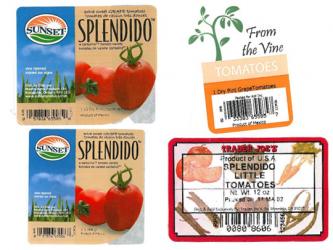
Wait - it gets weirder. Mastronardi Produce of Kingsville, Ontario (yes, that's Canada), also received some of the Six L grape tomatoes and is selling them under labels of "Aldi From the Vine (where else would they come from?) Grape Tomatoes", "Sunset Grape Tomatoes", and "Trader Joe's Splendido Little Tomatoes" all in neat little clamshell packages. And where are these being sold? Well, back we come across the border to the U.S. The Trader Joe's ones are being sold only in Eastern Seaboard and Midwest Locations. The others are sold in several other states (IL, MI, WI, FL, MA, MD, NJ, MD, OH, TX, WI). Did you notice, by the way, that some of those cute little grape tomatoes came right back to Florida again - presumably, from Ontario, Canada, under a new name?
Now comes my punchline. On April 26 - just about a week ago - representatives of Mastronardi Produce/SUNSET® were in Washington DC to accept the prestigious Dupont Food Quality Award for 2010. This award honors a North American business for outstanding food safety initiatives (There is a nice photo on their website of the award presentation). Mastronardi Produce won because “all aspects of the business appear to be aligned toward producing high quality, safe food within a sustainable environment.”
Hmm..Bad luck Mastronardi. You had better change the source for your grape tomatoes if you want to get the award next year.
TSF
It all started with a farm based in Estero, Florida, USA. They sent their grape tomatoes to Six L Packing Company, another Florida-based enterprise, that packages and distributes food products. According to Hoover's, Six-L packs and ships over 15 million boxes of tomatoes a year to other food companies and retailers in California, North Carolina, South Carolina, Alabama, Florida, New Jersey, New York, Michigan, Pennsylvania and Georgia, as well as Canada. In New York, a U.S. Department of Agriculture inspector found that some of these tomatoes tested positive for Salmonella bacteria. As often happens, the test results came a little late. At least two of Six L's clients had already sent them to our stores.
Taylor Farms Pacific Inc., which is based in Tracy, California, had used them to produce some 60 kinds of fresh salads. They were being sold in plastic trays at deli counters in key supermarkets including Albertsons, Raley's, Safeway, Savemart, Sam's Club and Walmart stores across the West and some Midwestern United States. (See post May 3).
Wait - it gets weirder. Mastronardi Produce of Kingsville, Ontario (yes, that's Canada), also received some of the Six L grape tomatoes and is selling them under labels of "Aldi From the Vine (where else would they come from?) Grape Tomatoes", "Sunset Grape Tomatoes", and "Trader Joe's Splendido Little Tomatoes" all in neat little clamshell packages. And where are these being sold? Well, back we come across the border to the U.S. The Trader Joe's ones are being sold only in Eastern Seaboard and Midwest Locations. The others are sold in several other states (IL, MI, WI, FL, MA, MD, NJ, MD, OH, TX, WI). Did you notice, by the way, that some of those cute little grape tomatoes came right back to Florida again - presumably, from Ontario, Canada, under a new name?
Now comes my punchline. On April 26 - just about a week ago - representatives of Mastronardi Produce/SUNSET® were in Washington DC to accept the prestigious Dupont Food Quality Award for 2010. This award honors a North American business for outstanding food safety initiatives (There is a nice photo on their website of the award presentation). Mastronardi Produce won because “all aspects of the business appear to be aligned toward producing high quality, safe food within a sustainable environment.”
Hmm..Bad luck Mastronardi. You had better change the source for your grape tomatoes if you want to get the award next year.
TSF
Wednesday, May 4, 2011
NEW U.S. FOOD SAFETY REGULATIONS - FINALLY!
They're out. Finally. The U.S. Food and Drug Administration (FDA) has just announced the first two new regulations to be released under the FDA Food Safety Modernization Act (FSMA). This Act was signed into law by President Obama in January of 2011
Here they are:
The first rule will give the FDA the right to embargo "suspect" food so that it can not enter the marketplace. This refers to food for which there is proof that it has been produced under unsanitary or unsafe conditions (such as incorrect pasteurization or canning, unsafe storage, lack of testing) but which may not as yet have a specific contaminant identified. I have been listing some under "Alerts". Basically, this will give the FDA up to 30 days to see what other measures should be taken (hopefully the food will not go bad in the meantime).
The other rule relates to imported foods - both for humans and animals. This rule requires that anyone importing food into the U.S. has to inform the FDA if any other country has refused entry to this same product. Yes, it happens: a product refused entry by one country, because it is found to be harmful, is then sent off to another unsuspecting one, hoping no one will find out. There have been some embarrassing situations over the years.
Personally, I think these are good regulations, which should help to make the U.S. food supply safer. What I particularly like, is that we are going further upstream in terms of prevention.
Both rules will take effect July 3, 2011.
TSF
Here they are:
The first rule will give the FDA the right to embargo "suspect" food so that it can not enter the marketplace. This refers to food for which there is proof that it has been produced under unsanitary or unsafe conditions (such as incorrect pasteurization or canning, unsafe storage, lack of testing) but which may not as yet have a specific contaminant identified. I have been listing some under "Alerts". Basically, this will give the FDA up to 30 days to see what other measures should be taken (hopefully the food will not go bad in the meantime).
The other rule relates to imported foods - both for humans and animals. This rule requires that anyone importing food into the U.S. has to inform the FDA if any other country has refused entry to this same product. Yes, it happens: a product refused entry by one country, because it is found to be harmful, is then sent off to another unsuspecting one, hoping no one will find out. There have been some embarrassing situations over the years.
Personally, I think these are good regulations, which should help to make the U.S. food supply safer. What I particularly like, is that we are going further upstream in terms of prevention.
Both rules will take effect July 3, 2011.
TSF
Tuesday, May 3, 2011
SALMONELLA OUTBREAK SEASON IS BEGINNING IN THE U.S.
Salmonella bacteria are a very common cause of food poisoning. Usually, the symptoms are ones like diarrhea, vomiting, nausea, abdominal pain or cramps, weakness, fever. These organisms can cause serious and sometimes fatal infections in young children, people with weakened immune systems and those who are frail or elderly. Some members of this family of bacteria are particularly vicious.
Most Salmonella outbreaks in the United States food supply, and particularly in fresh produce, occur in the spring or early summer…In other words, about now. And right on schedule, here we go. During the last 12 days, Salmonella has cropped up in several of those nice healthy foods most of us eat, which are now being recalled:
• In cucumbers, distributed by L&M Companies, Inc. of Raleigh, North Carolina. There aren’t many recalls of cucumbers, so this is somewhat unusual.
• In alfalfa sprouts, distributed by Jonathan's Sprouts of Rochester, MA. Alfalfa sprouts are one of the riskiest food you can eat, and every year there are a number of outbreaks and recalls.
• In cilantro, distributed to food service customers, by Satur Farms of Cutchogue, New York. Salmonella in cilantro is also not unusual.
• In grape tomatoes grown by Six L’s of Immokalee, Fla.. In turn, these tomatoes were used by Taylor Farms Pacific of Tracy, California, for some 70 different ready-to-eat salads for Albertsons, Raley's, Safeway, Savemart, Sam's Club, & Walmart. (Wouldn’t you think that a label which includes the word “Farms” would be growing their own produce instead of bringing it from Florida?). For the entire list of RTE products under recall, go to: http://www.fda.gov/Safety/Recalls/ucm253580.htm (It is too long to reproduce here).
• And….......
There are more to come. Summer is just beginning. So is Salmonella season.
TSF
Sunday, May 1, 2011
CHILDREN ARE MORE AT RISK FROM RADIATION
I have a new hero. His name is Toshiso Kosako. Until recently, he held the very prestigious position of Senior Nuclear Adviser to the Government of Japan. But I don’t admire him because of his importance. I admire him because he gave it up, and for the reason he gave it up. That took a lot of guts and showed tremendous integrity.
Among the reasons he reportedly gave up the adviser post was that he could not go along with allowing children living near the crippled Fukushima Daiichi nuclear plant to receive doses of radiation that are equivalent to levels established for adult nuclear power plant workers. He understands that they are more vulnerable. This greater vulnerability also applies to any nuclear (or other toxic) contaminants they receive from food.
When this crisis began, I blogged the special dangers pregnant women needed to be aware of. Maybe I should have given more attention to infants and young children. Their bodies are much smaller, and therefore a small quantity of a toxic substance can affect them as much as a larger quantity would affect an adult. Their brains and bodies are also still developing and can be easily damaged. In addition, infants are sometimes more vulnerable to toxic substances in the environment because they crawl and put things in their mouth. In fact, they could be exposed from several sources - the atmosphere, direct contact with contaminated surfaces, and contaminated food and water.
But a final thought on the food issue: infants and young children can also be more exposed to toxic iodine and cesium from radiation-contaminated food, because they rely on a limited range of food and drink, day after day. This concentrates their risk. If one of these is contaminated - such as milk, apple juice, certain vegetables, it can be very bad news indeed.
Thank you Mr. Kosako, for speaking out for children.
TSF
Among the reasons he reportedly gave up the adviser post was that he could not go along with allowing children living near the crippled Fukushima Daiichi nuclear plant to receive doses of radiation that are equivalent to levels established for adult nuclear power plant workers. He understands that they are more vulnerable. This greater vulnerability also applies to any nuclear (or other toxic) contaminants they receive from food.
When this crisis began, I blogged the special dangers pregnant women needed to be aware of. Maybe I should have given more attention to infants and young children. Their bodies are much smaller, and therefore a small quantity of a toxic substance can affect them as much as a larger quantity would affect an adult. Their brains and bodies are also still developing and can be easily damaged. In addition, infants are sometimes more vulnerable to toxic substances in the environment because they crawl and put things in their mouth. In fact, they could be exposed from several sources - the atmosphere, direct contact with contaminated surfaces, and contaminated food and water.
But a final thought on the food issue: infants and young children can also be more exposed to toxic iodine and cesium from radiation-contaminated food, because they rely on a limited range of food and drink, day after day. This concentrates their risk. If one of these is contaminated - such as milk, apple juice, certain vegetables, it can be very bad news indeed.
Thank you Mr. Kosako, for speaking out for children.
TSF
Subscribe to:
Posts (Atom)